Showing posts with label Favorite Books. Show all posts
Showing posts with label Favorite Books. Show all posts
June 14, 2020
Literate Discussions 7: William Carlos Williams
I enjoyed taking part in this sprightly discussion with Professor David Hornbuckle from the University of Alabama at Birmingham on his show Literate Discussions about two classic Imagist, Modernist poems by William Carlos Williams, "The Red Wheelbarrow" and "This Is Just to Say."


July 06, 2018
Render Kindle Edition Now Available for Pre-order!
 I'm thrilled to announce that the Kindle edition of Render, my first poetry collection, is now available for pre-order. It will be delivered July 12, 2018.
Paperback and iBooks editions are coming very soon!
A teaser from "Early AM Mysteries":
Nothing remains to believe
except the possibility of belief—
lessening the definition of hope
into nothing more substantial
than bones and skin and
the terror of daybreak.
In the silence of the overnight,
the refrigerator’s sudden buzzing
is a muted alarm, a warning cry
of omen and portent as I leap
from futon to coffee table to loveseat,
afraid of the ravenous piranhas
lurking beneath the surface
of the gray industrial carpeting.
I am tired
of proclamations of doom.
The damp cold is an uninvited guest
boring me with oft-repeated tales
of miseries more dire than my own.
My constant self-imposed solitude
has bewildered the boundaries
of the real and the actual,
like this snowy mountain peak
I hold in the palm of my hand.
The full version of this poem is included in the Kindle edition of Render.
Thanks!
Gene
March 25, 2018
Bernie's Best Jokes Memes
Give your kids the giggles!
Kooky clean jokes for kids!
(Or for your inner child!)
I'm going to try to keep making these little ads on a regular basis, as memes seem to be the unit of transmission on the internet these days.
Anyway, these were made for the express purpose of letting people know that the book Bernie's Best Jokes exists, as well as introducing the types of jokes involved in it, along with a taste of the goofy pictures inside, too.
Click any of the memes to go to the free sample jokes page on jebright.com, or sometimes to the purchase page on Amazon.
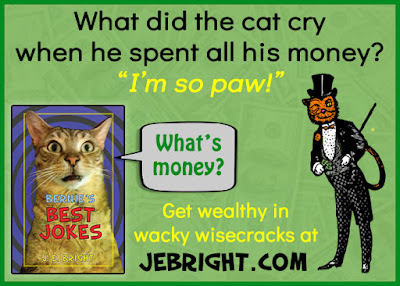


Get your paperback or Kindle edition now!
April 10, 2014
Review: Great Pleasures

Great Pleasures by Edward Southgate
My rating: 5 of 5 stars
A sexy, funny, familiar, and poignant collection of narrative essays and poetry about gay sex and love on the cusp of middle age.
October 19, 2013
Review: A Wrinkle in Time: The Graphic Novel

A Wrinkle in Time: The Graphic Novel by Hope Larson
My rating: 5 of 5 stars
Devoured this in one great gulp. OMG, it made me cry so hard. Meg. Calvin. Charles Wallace. Aunt Beast. Gorgeous and extremely effective.
October 02, 2012
Review: Gone With the Wind

Gone With the Wind by Margaret Mitchell
My rating: 5 of 5 stars
I'm going to try to reign in my hyperbolic superlatives when discussing this book, because I've rarely been so impressed by a novel and engrossed in a story in my life.
It would be almost impossible for me to discuss this book without comparing it to the movie. I've seen the film dozens of times, way back further than I can remember, as it was one of my mother's favorites and we watched it as often as it was on TV. I love the movie, and can quote huge chunks of it by heart. But I always avoided reading the novel because I figured it would be too Southern, too cheesy, too earnest, too racist, and in every respect less enjoyable than that landmark film.
It's weird that I thought this. Generally, books are always better than their adaptations. The two examples that spring to mind of movies that are better than their books are The Lord of the Rings trilogy (I found the books unbelievably boring) and The Wizard of Oz (I adore the Oz book sequels, but the first book is not as magical as the musical movie). Maybe I was conflating Oz and Gone with the Wind somehow: they both go back further into my childhood than I can remember, they're both from 1939, and they're both directed (mostly) by Victor Fleming. Who is a freaking genius, and I must remember to watch more of his films.
The movie of Gone with the Wind is a terrific, even awesome adaptation, incredibly well-acted and impressively pared-down, but the book is better. It is so much more than the movie. Everything in the movie that I loved was created wholesale in the book. I thought that Vivian Leigh had imbued Scarlett with all that passion and life and attitude and sass, but she was merely keeping up with the portrayal of Scarlett in the novel. (Even that is truly amazing.) All the characters are fully-formed on the page, in intricate and breathtaking detail. They are more complex than I ever expected, more believably contradictory, more in sway to their own natures, more tied to their roots and destinies, and more surprising than I thought possible, especially given that I already knew them from more than four hours of some of the best acting ever on the silver screen. The book is about character, how personal strength and weakness affects not only one's own fate, but the destinies of everyone around you. It's about different types of strength, with Scarlett set up with the best foil ever, Melanie Wilkes, showing the power in kindness and belief in goodness, versus Scarlett's fierce pragmatism. I love them both so much. Really, Scarlett and Melanie may be the best characters ever created in American fiction. I adore them more than Huck Finn, or even Scout. Who else comes close?
Because Scarlett's character is so closely and finely delineated, with such fundamental humanity, she almost comes off as a satirical character like a Jane Austen heroine. Check out this sentence describing Scarlett's resolve from the end of Chapter 4:
She lay in the silvery shadows with courage rising and made the plans that a sixteen-year-old makes when life has been so pleasant that defeat is an impossibility and a pretty dress and a clear complexion are weapons to vanquish fate.
That's all true, but it isn't exactly without a satirical eye. Scarlett is unquestionably our heroine throughout, but Mitchell makes fun of her, teases her, pops her pretentions, even as she celebrates all her qualities, too. The book is hysterically funny, even at its most epic and dramatic, mainly, I think, because the characters are so deliciously recognizable at all times. I was often swept into laughter and tears just because Melanie was so completely herself that it stole my breath away. And the same goes for all the other characters: Scarlett, Rhett, Mammy, in particular. Ashley is himself, always, but he also is a giant pussy and basically sucks as a human being who can only thrive in rarified air.
Sexy scoundrel Rhett Butler adds to the satirical air, with his sarcastic zingers, scandalous smarts, and superior charm. He's ultimately a tragic figure, and you end up pitying him for his love and pride, but the depth to which he understands Scarlett and sees through her are crucial to the story. Like Scarlett does, though, it's easy to take Rhett for granted. He's there, dependably exciting, funny, dashing, and brave, and as much as I love him, I'm not completely convinced that Scarlett falls for him by the end, despite her interior monologues that usually signify truth. Nor do I believe that he'll be able to stay away for long. They're like hydrogen and oxygen: they just click together, chemically and karmically. But even someone as joyful and strong as Rhett can't fully stay afloat in Scarlett's dramatic tsunami. Wow, the two of them are so beautifully and completely realized that I must pay them the highest compliment: they don't feel fictional. They live.
So, okay, the characters are in there, the epic sweep is in there, the wonderfully zippy plot is in there against the fascinating and frightening backdrop of the Civil War, the humor and sorrow and passion and drama is all in there. But there's so much more about the war than could fit in the movie, so much more about the South, and there are other important characters we'd didn't get to meet in the film, like Ellen, Scarlett's mother, and Scarlett's children from her first two marriages. I loved all the expansion of the story; it's breadth is breathtaking.
What else is breathtaking? Oh, yeah, the racism intrinsic to the setting. There are slave and free black characters who come fully alive as people in defiance of the attitudes of the South (Mammy, Dilcey, Pork, etc.), but wow, slavery was so entrenched that the people who were born into its mindset cannot see outside no matter what happens. There is no moment like when Huck Finn "humbles himself to a nigger" and apologies to Jim -- Scarlett loves the "darkies" in her family, but she's deeply racist to a point that she'll never realize. Pork even tells her that she's nicer to blacks than to whites, and that may be true, but it's born of her practicality and pragmatic humanity, not equality. They left out of the movie that Ashley Wilkes and Frank Kennedy were members of the Ku Klux Klan in the book . . . for some reason, that probably wouldn't have been positive additions to their characters in the flick, but in the novel they are Southern Gentlemen of the oldest school, with all that signifies. (And the significance of the attitudes of the Southern gentry is the main thing that went "gone with the wind" following the war.)
The prose is tight and muscular and lyrical throughout, with very little pretension -- all the writing is in the service of the story. It's a long, long book, but I lived in it, carrying it the world around with me even when I wasn't reading it. Mitchell sometimes overdoes description of emotional states, stating the obvious and already-implied, but it's always impressive how finely rendered the characterizations are. She steps out of point-of-view on occasion, too, following some surprising character's POVs, but mostly we're happily aligned with Scarlett as she scratches and claws and charms her way through life, surviving an existence more dramatic than any one person could seem to handle.
Overall, Gone with the Wind must count as one of the best novels I've ever read. Truly wonderful.
January 08, 2012
Favorite Books: Sylvester and the Magic Pebble

One of my favorite books of all time is Sylvester and the Magic Pebble by William Steig. It was published in 1969, and won the Caldecott Medal in 1970. I was born late in 1969, and I don't remember the first time I was read this book, so my mother must've gotten it pretty early on. I still read it regularly, and it's become my standard favorite children's picture book, up there with Maurice Sendak's Where the Wild Things Are and Shel Silverstein's The Giving Tree.
Sylvester and the Magic Pebble is a frightening, magical story about a young donkey named Sylvester who likes collecting unusual pebbles. One day, while out walking alone on a rainy day, he finds a shiny red pebble, and while holding it, offhandedly wishes the rain would stop. The rain CEASES, and after a few tests, Sylvester realizes that the pebble grants wishes as long as he is holding it.
 Thrilled about his discovery, Sylvester heads home with big plans for the pebble's magic, but on the way, he is spotted by a hungry lion. In panic, Sylvester doesn't think clearly, and to protect himself, wishes that he was a rock. And so he turns into a rock, safe from the lion, but with the pebble lying beside him, not quite touching him, Sylvester can't turn himself back into a donkey.
So Sylvester is stuck as a rock, unable to get home to his loving parents, unable to do anything but lie there and wait, powerless. That's the stuff of childhood nightmares -- being separated from home, transformed into something unrecognizable and immobile, with all the power in the universe lying right beside you but unreachable. By acting quickly without thinking, Sylvester traded one danger for something even worse.
 I always found the worry on his parents' faces so touching as they start searching for him. It's wrenching how they slip into despair as Sylvester is nowhere to be found, even after asking all the kids in the neighborhood, the police, and sniffing dogs to search him out. And all the time, Sylvester is just less than a mile away, unable to return home. It hits home with every child how sad his parents felt. As Steig writes, "They were miserable. Life had no meaning for them any more."
The seasons pass, and Sylvester slips into the ennui of being a rock, sleeping so he won't feel "hopeless and unhappy". There's one snowy winter scene in which a wolf sits on the Sylvester-rock and "howled and howled because he was hungry." I always loved that so much -- the wolf crying out in hunger mirroring Sylvester's endless desire to return home. The illustration is white and cold, and just heartbreaking.
Finally, in Spring, Sylvester's parents go have a sad picnic, and through sheer coincidence, set up their umbrella and basket next to the Sylvester-rock, and eat right on top of him. They talk about him, but he can't respond, which is maddening. His mother even has a feeling that he is near. His father finds the red magic pebble, and puts it on top of the rock, saying how much Sylvester would have loved it for his collection.
 Sylvester wishes he was "my real self again" and presto!, he returns to being a donkey. They rejoice in surprise, which will still reduce me to tears on occasion. Then they go home together, and have no need to use the pebble's magic, because, "for now, what more could they wish for? They all had all that they wanted."
In simple, direct language, Steig weaves a emotional, psychologically and philosophically complex tale that has never stopped resonating with me and millions of others. The story is deeply sad and quite terrifying, really, but the drawings have lots of humor, too, like the ducks in the river looking up in surprise when Sylvester wishes the rain away, the consternation on the face of the lion when Sylvester turns into a rock, and the dishes falling off Sylvester's back when he transforms back into a donkey.
 Even as a child, I also knew it was funny that the police in town were drawn as pigs, but that's also caused the book to be banned in various places. Whatever -- it's a tiny subversive touch that only makes me love the book even more.
It's a perfect children's book, and will always be one of my all-time favorites.
Subscribe to:
Posts (Atom)