 |
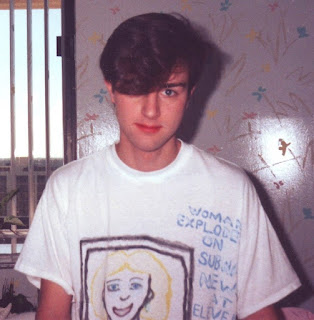
| Me in 1988, when I was listening to most of this list. |
So I did that 10-day "post covers of your most influential albums" challenge on Facebook, and as I rather like how it came out, I thought I'd share it here, too, all collected together.
It was fascinating to trace back to the roots of my musical interests, and piece together which begat what. Much of my taste was influenced by the Second British Invasion of the 1980s, especially post-Punk New Wave technopop and Gothic or Shoegaze dreampop. I was never a Goth myself -- I was styled as inconspicuously casual as I am now -- but I certainly hung around the Goth and Punk kids, because they were interesting, accepting, artistic, and they smoked.
The main subject of my life is the English language, so these genres further fed my Anglophilia. Which may be genetic, as I just found out from a DNA test this Christmas that I'm 40% British, and which also may explain why I looked like Harry Potter most of my life, round glasses and all. I spent 1989, my junior year abroad, in Lancaster, UK, which certainly didn't lessen my interest in their culture or music. Anyway, fully half the records on this list are albums by British musicians.
My heart aches for those I left out, like Michael Jackson, The Cars, Sinead O'Connor, The Cure, Violent Femmes, the Human League, and Madonna, but 10 is 10 and life is full of tough choices, innit?
#1: The Queen Is Dead, The Smiths (1986)
Because,
yeah.
I received two copies of this vinyl LP from separate friends for my 16th birthday in 1986. It took some determination back then to gain entry into the music, as I didn't really understand the subtleties of guitar. I'd only really listened to harder guitar music like Van Halen and AC/DC, and while they're virtuosic, they ain't subtle. Something about
The Queen Is Dead seemed so old-fashioned at first, with big band, Beatles, doo-wop, girl-group, and folk influences that all felt like a throwback to when Rock could be a thing on its own. I didn't know the Velvet Underground or the New York Dolls yet, so I didn't recognize their influences.
My persistence in slowly learning this album came with a lifetime of rewards once I began to decipher the lyrics, and the hooks dug into my soul. Holy shit, I thought, here's someone who not only understands, but is perhaps worse off that I am! And he's honest and funny and miserable about it, and isn't afraid to be poetic and romantic and angry and tormented if that's what he's feeling. Could he also be . . . gay? Is this camp? Is this what I've been waiting for forever?
That's when I joined the Cult of Morrissey, admiring his voice and attitude and heart and hair from afar, although there have been plenty of times in the past decade when I wish he would shut up.
The more I listened to the music, analyzing its composition, the more I was surprised by the shades of meaning and tonality, the intelligent, creative improvisational musical commentary on the lyrics, that Johnny Marr managed to write on this record. It's gorgeous in spots, and unspeakably sad, and jiggy and funky and soft and delicate and swooping and head-banging and shimmying. It's Rock. It rocks.
So The Queen Is Dead taught me to love
guitar music, to be brave enough to express myself in poetry, and to delight in the fine lines between
misery and hilarity, love and violence, sensitivity and aggression, and
subterfuge and coming out. Many lyricists have tried, but nobody has come close, especially matched with the melodic genius of this music, although I've never stopped looking and I suppose I never will.
#2: Technique, New Order (1989)
Unlike almost every other record that
I played to death in my youth, this album still sounds good to me, and it's so layered that I still find new things in it, almost 30 years later.

It's not my first New Wave technopop or Britpop album, or my even my first New Order album (that was
Low-Life), but
Technique is my
favorite.
There's a rhetorical simplicity in the lyrics, a distillation of
complex subjects into basic, direct language, that I greatly admire as a
children's writer, with meanings that arise stealthily over the years in
delayed and indelible hooks.
Lovely Bernard's voice is not exactly powerful,
but it's got heart and attitude and I'm able to sing along. The music builds
great glass cathedrals in my mind, drenched in Ibiza sunshine, while moving my feet and body to the acid house rhythms, especially that iconic bass. The beat sounds like my own personal internal syncopation, and the twinkling, intricate sounds of the guitar and synth
harmonize with the electrical sharpness of my own thoughts.
To me, it is the
most immersive music in the world, the soundtrack to my life, and the music I'm
most likely to synchronize with as I walk around the world, so often reaching
an ecstatic state in which the movement of everything around syncs up, too, in
a communal dance of connection, and I become one with it all. It's the music of
my spheres.
So, yeah, Technique.
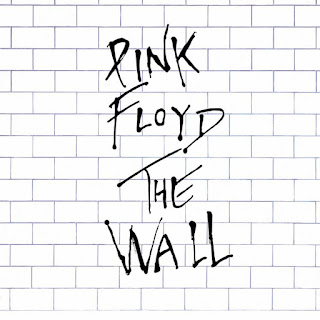
#3: The Wall, Pink Floyd (1979)
I was in 3rd Grade when this came out,
and I remember going over the lyric sheets with friends in the cafeteria,
explaining the words to them, particularly what "dark sarcasm" meant.
Because we all had "Another Brick in the Wall, Part 2" stuck in our
heads.
It wasn't until high school that I really sat down and
listened to the whole album through, and then over and over again with chunky
headphones on, poring over the lyric sheets, flipping the LPs, memorizing the gorgeous
poetry, getting lost in the imagery, tripping in the music, putting together
the whole story.
More like reading a novel than any other album I've ever
heard, The Wall is one of the most complete experiences in any media, with
musical genres ranging from marches to gorgeously melodic laments to funky sex
binges to dreamy odes to psychological self-laceration to horror ballads to furious hell-raising
rock rip-'em-ups.
I never understood why it was considered a stoner album,
really. It's not mellow in any way. It's one of the angriest and most
existentially disconnected cycles of songs ever written, about the intrinsic
conflict between people on micro and macro levels, relationships and war, about
external and internal fascism, about the pain of creative endeavor, and how our
unresolved histories can undermine our moments of triumph, and ultimately about
how earnest expression and revelation may be the only thing that can save us.
It's influential in that I'm always seeking something to
compare it to in scope and darkness, but nothing ever comes close.
#4: Living My Life, Grace Jones (1982)
I first heard Grace Jones's
Living My Life in the early '80s
at my Aunt Pat's apartment on 9th and Broadway. She had the LP, and I copied it
on cassette, and have listened to it continuously since. (Obviously not on
cassette anymore.)
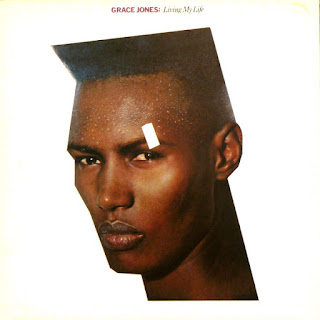
There's not a bad song on this album, but the one that first
got me was "The Apple Stretching," a song about early morning NYC
that I deeply recognized. (It was written by Melvin Van Peebles for his 1982
play Waltz of the Stork!) At the time, I related to the song from going to
school in the morning, but I also knew that it was about a blissful walk of no
shame coming home at dawn from a club, which was extremely aspirational to me,
and which I've now experienced and loved countless times. There's something
about NYC when you've been up all night and the city kicks into gear around you that is
always inspiring.
I can't go through every song, because this would be a major
essay, but this album has some of the funkiest, raunchiest, coolest tracks ever
produced. It's post-Punk, post-Rock, post-Disco, Warholian club music, harder
than New Wave, and thrillingly dangerous. Grace's attitude initiates so much of
the best of current American culture, from the gender-bending to women's
empowerment to global consciousness. Her own influences range from The Velvet
Underground to Donna Summer to Edith Piaf to the New York Dolls, connecting it
all with her own ferocious fierceness that places her as a precursor to nearly
every dance goddess since.
This album both shakes and kicks ass.
#5: Really
Rosie, Carol King and Maurice Sendak (1975)
It was between this and Free to Be You and Me, but I went
with this one because I still listen to it. Frequently. Like, I have
"Alligators All Around" on my phone now. Sometimes I sing it in my
head when I can't fall asleep.
This is like my personal supergroup. Like Roxette! Except,
you know, awesome. Yeah,
Tapestry is a better album, and
Where the Wild Things
Are is a better book, but this is kind of the Ur-album for a children's book
writer. It also led me into folk music, '50s and '60s girl-group pop, and
Broadway showtunes.
Plus it has this stanza, from the title track:
I can sing, "Tea for two and two for tea."
I can act, "To be or not to be."
I can tap across the Tappan Zee.
Hey can't you see . . .
I'm terrific at everything.
No star shines so bright as me.
Rosie!
Believe me!
Although that last line has some Trumpian connotations
nowadays, this song is like the ode to creative confidence, and really,
confidence is the key to everything.
Also, Pierre says, "I don't care," which is also sometimes the key to everything.
#6: Some Great Reward, Depeche Mode (1984)
I rarely listen to Depeche Mode's
Some Great Reward
anymore (the songs from
Violator seem to have aged better), but I'd be lying if
I didn't mention this album as a major influence. It was really the first New
Wave technopop album that I went out and bought, and it kicked off a lifetime
of melodic electronica.
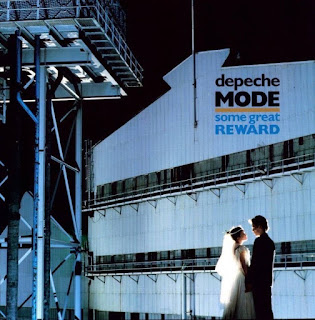
It sounds adolescent to me now, but
I'm not sure if that's because I listened to it endlessly during my adolescence,
because I memorized every note and syllable and leached them of surprise, or
because its twinkly, proto-Industrial, Goth-lite earnestness didn't stand the
test of time.
Whichever -- this was my teen sulking headphone music, my dance
when nobody's watching album, the record of my hopeful, pining gay gloom, and
it set an initial blueprint for my musical tastes that would be ridiculous to
deny.
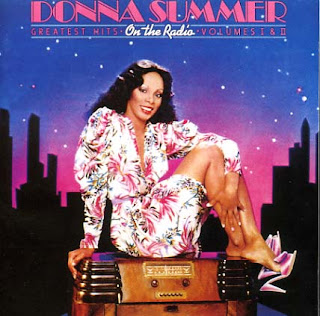
#7: On the Radio Greatest Hits, Donna Summer (1979)
I can't really remember
a time before Donna Summer. I mean, "Love to Love You Baby" came out
when I was 6. My younger aunts and uncles danced to her in my grandmother's
house, and she was making everyone move on TV. I loved Disco. I loved Giorgio
Moroder, who I realize now was the link from early harsher, minimalist
electronica like Kraftwork, making it irresistible for dancing, building the
foundation, after Punk, for what would become New Wave. Donna's Disco
sounded space-age, and fast, and dirty, and sometimes even ethereal. If there's
one culprit for my abiding love of New Wave electronica trance, dance, and pop,
it's this album. (Although there are a couple other major influences for that
coming up.)
Then there was Donna's voice. She was sultry and sleazy and
sure and strong, but also sometimes sweet and sad. I didn't realize how amazing
she was until decades later, when I realized how unparalleled her power and
range and rhythm were, how insistently she sang. She overpowered Barbra
Streisand, even, singing with such smooth groove in their duet that she made
Babs sound like she had a stick up her butt.
This album, the greatest hits 2-record collection On the
Radio, we had both on vinyl and 8-track. (Some of the songs I still remember
with a loud KA-THUNK noise in the middle when the 8-track abruptly changed
tracks mid-song.) My brother and I would spin around
the living room to it like whirling dervishes. It's a terrific album, with "On the Radio,"
"Love to Love You Baby," "Heaven Knows," "Last
Dance," "MacArthur Park," "Hot Stuff," "Bad
Girls," "Dim All the Lights," and "No More Tears (Enough Is
Enough)." But most importantly, it has "I Feel Love," which is a
strong contender for my favorite song of all time.
I still listen to the songs on this Donna Summer
album regularly, although now most of them are from the greatest
hits collection Endless Summer, which includes the later '80s hits.
I miss her.
#8: The Best of Blondie, Blondie (1981)
This was the first Blondie album I
bought, but that wasn't until college, on cassette. They had just been in the
air before that, unavoidably, always on the radio, at parties, on MTV, in
stores, everywhere. Like for Whitney Houston, there was no need to buy an
album, because all you had to do was sit up and listen and there they were.
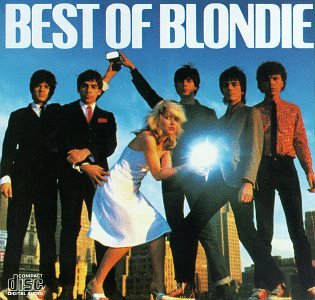
As a kid, I loved "Call Me," which made me think
of a mixture of naked Richard Gere and Debbie Harry's awesome guest spot on The
Muppet Show. Of course, it's Giorgio Moroder producing again, who really is the
progenitor of my most frequent music.
Then, "The Tide Is High" was at all my 6th Grade
graduation parties, and was one of the earliest songs I couldn't stop singing
to myself, my first adult earworm.
"One Way or Another" doesn't even sound like it
was written by anyone, like it's some anonymous rock tune from the classic
American songbook. It's perfect and eternal and scary.
"Heart of Glass" is one of my favorite songs ever,
a moment when Disco melds into ethereal druggy trance.
And "Rapture." This was really the one I always
stopped to listen to, on MTV, and on the radio in my room,
around the same time I started to leave the radio on all night while I slept so
I could hear and absorb the music in my dreams.
Chris Stein and Debbie are a major nexus for so much
of what followed, jumping genres from Disco to Rock to girl-group to Reggae to
Funk to Punk to Hip-Hop to New Wave, bringing it all to the mainstream.
"Rapture" was the first number one song in America to feature rap
vocals. How insanely influential is that?
Plus Debbie's gorgeous and instantly recognizable voice
growls low and soars high. She's the quintessence of cool.
A good case could be made for Blondie being the most
influential group in modern American popular music.
#9: Behavior, Pet Shop Boys (1990)
I had liked, even loved, the Pet Shop Boys from their first
song, "West End Girls," and through the first three albums from
1986-1988. I'd always deeply dug their poppy New Wave dance melodies and rhythms,
the catchy, clever lyrics, the Disco and Jazz influences, Neil Tennant's rebellious,
sometimes disaffected choirboy voice, and the barely-hidden gay subtext. They
wouldn't come out officially until 1994, but before that, in 1990, Behavior
came out, and I'll forever compare every other album afterward to it.
I can't tell you how many times I've listened to this album,
but it regularly ranks at #1 in my most played at
Last.fm, only beaten by Donna Summer on occasion. (And
Sufjan Stevens, but he doesn't count as an influence: he is the influenced.)
Produced by Harold Faltermeyer, Behavior takes PSB's dancey
technopop and softens and deepens it, adds vulnerability and heartache and a
kind of earnest cynicism which informs the sensibility of my entire life. It
also adds pop guitar, performed by The Smiths' Johnny Marr, as well as a historical
lyricism along with the interpersonal introspection, all of which they fight
against as much as embrace.
I love the music that Chris Lowe makes, which seems to
stream out of him in concert like he's at the center of a vibrant kaleidoscope,
but that in combination with Neil's intelligence and plaintive voice became
inimitable on this album, unmatched until perhaps Radiohead and Sufjan came
along.
This album is a primer for my whole worldview, and my entire
matrix of behavior.
#10: Saturday Night Fever, soundtrack (Bee Gees, etc.) (1977)
Here it is, the major root of the tree of my musical tastes, the Saturday Night Fever soundtrack. It's the bestselling soundtrack of all
time, and the 7th bestselling album overall, with about 45 million units sold.
I have it memorized, inside and out, and if you put a gun to my head and
demanded to know my favorite song, I might name "How Deep Is Your
Love?," which is also my favorite slow dance song.
I like a lot of the other songs on it, like "A Fifth of
Beethoven," and "Boogie Shoes," but it's the Bee Gees tunes that
get me. Sure, they're a little ridiculous, and so very '70s discotheque. But it's
their folk rock foundation and harmonies tied to the electric guitar and early
synth, funk bass, and newly-invented drum loops of dance music that make this
the most influential album of my life. It shimmers and scintillates and demands
dance.
Plus the singing. Something about that upper-upper register
resonates with me across all my musical tastes, and Barry Gibb may have the
best falsetto of all time, with an odd masculine and feminine power to it. It can
sound otherworldly, alien, but also emotional and heartfelt, while his brothers
give him a solid base of harmonies so it can soar while they keep him grounded.
I wouldn't say the Brothers Gibb are underrated as
songwriters, because they are responsible for some of the biggest hits in music
history and have been inducted into the Songwriters Hall of Fame, but it's
worth mentioning how well constructed the songs are. Their list of hits for
other singers is mind-blowing, from Al Green's "How Can You Mend a Broken
Heart," to Dolly and Kenny's "Islands in the Stream," to Frankie
Valli's "Grease," to "Emotion" by Samantha Sang (and
Destiny's Child), to Barbra Streisand's "Woman in Love," to Diane
Warwick's "Heartbreaker," to Yvonne Elliman's "If I Can't Have
You," etc. But I love the Bee Gees versions even better, because of their strange
and eerie voices.
Then there's John Travolta's stank all over this
thing. He was like a cartoon of Italian/Irish male sexuality, and man, could he
dance. Barry Gibb was ridiculous looking himself, and so cheesy in retrospect,
but in 1977 my little mind was blown by how hot he was, to the point where I
was afraid and embarrassed to look at him.
Y'all know how influential this album is to all dance and
electronica music and MOR Top 40 that came after. Really, it's the other limb on the pop tree
alongside rock-and-roll.
In their biggest hit, I'm reminded of a section from William
Carlos Williams's long poem, "Spring and All":
What the hell do you know about it?
AXIOM
Don't get killed.
Careful Crossing Campaign
Cross Crossings Cautiously
Yeah, perhaps the greatest priority in life is to keep staying alive.


 It's not my first New Wave technopop or Britpop album, or my even my first New Order album (that was Low-Life), but Technique is my
favorite.
It's not my first New Wave technopop or Britpop album, or my even my first New Order album (that was Low-Life), but Technique is my
favorite.


 It sounds adolescent to me now, but
I'm not sure if that's because I listened to it endlessly during my adolescence,
because I memorized every note and syllable and leached them of surprise, or
because its twinkly, proto-Industrial, Goth-lite earnestness didn't stand the
test of time.
It sounds adolescent to me now, but
I'm not sure if that's because I listened to it endlessly during my adolescence,
because I memorized every note and syllable and leached them of surprise, or
because its twinkly, proto-Industrial, Goth-lite earnestness didn't stand the
test of time.


 Chapter and Verse: New Order, Joy Division and Me by Bernard Sumner
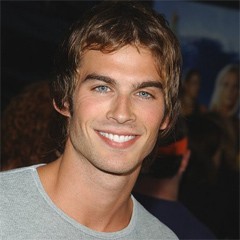
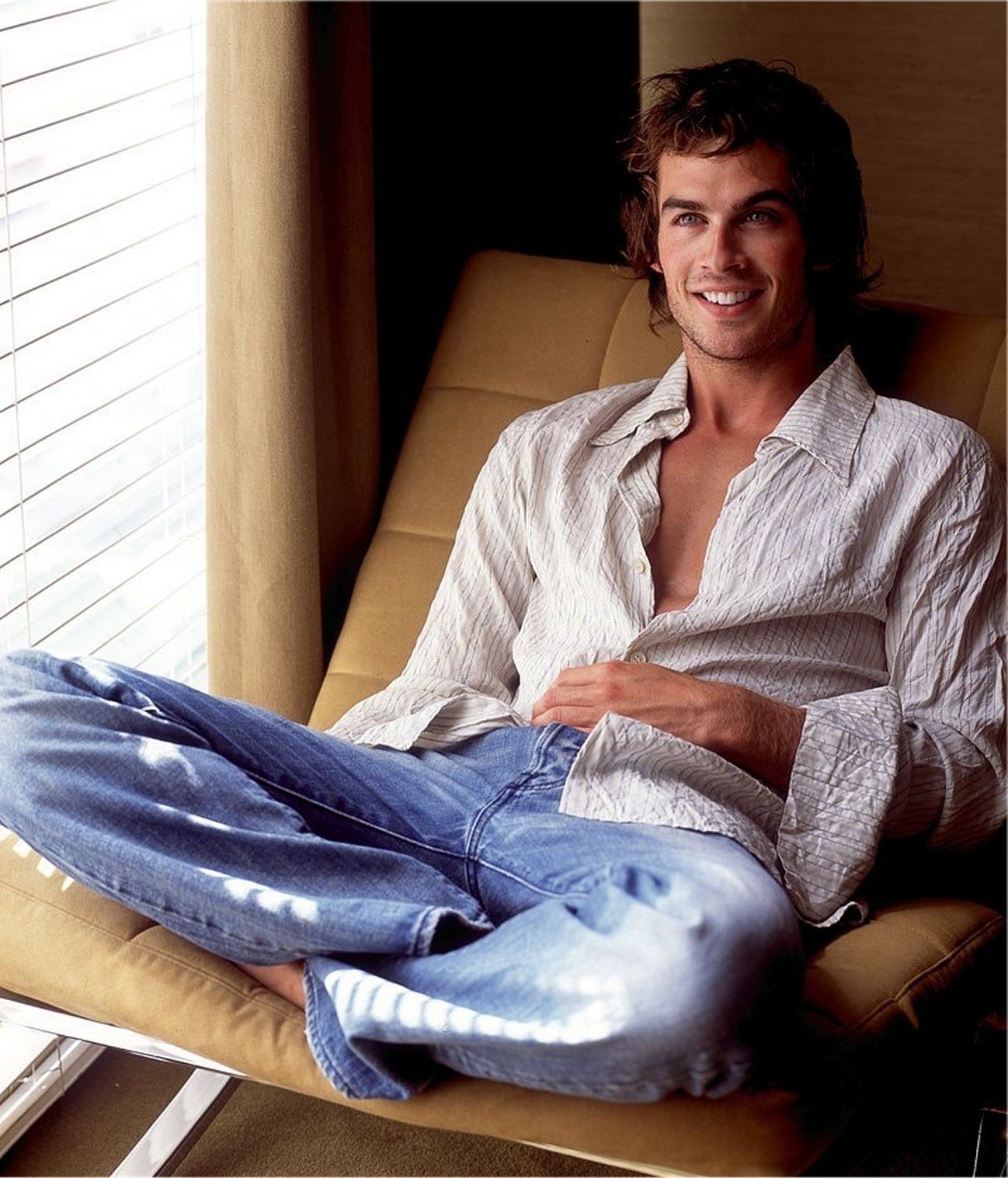
 Ian Somerhalder (born December 8, 1978) has been one of my main celebrity crushes for a decade now, since his role as the snotty gay rich kid Paul Denton in the 2002 movie The Rules of Attraction. I fell for his amazingly symmetrical features, intense blue eyes, and of course those arched eyebrows. I love his slender, muscular body, too, but it's his attitude that really gets me, that beautiful troublemaker's intelligent rebellion with a cocky assurance despite obvious interior loneliness and insecurity.
 Plus, in Rules of Attraction, he dances around in his underwear. Irresistible. I'm not made of wood, people!
 Happily, Ian is now on The Vampire Diaries, where I can watch his sexy cockiness as the undead Damon Salvatore to my heart's content. It's also a good show, with breakneck plotting and complicated, likable characters.